Chicken Road 2 vs Chicken Road 1: Which Is Better?
CR2 has more lanes and a higher theoretical max win, but lower RTP. CR1 offers better RTP at 98.1% but fewer lanes across every difficulty tier. Here is the full breakdown.
Table of Contents
At a Glance
🐔 Chicken Road 1
🚗 Chicken Road 2
Full Comparison Table
| Feature | Chicken Road 1 | Chicken Road 2 |
|---|---|---|
| Theme / Setting | Dark sewer & dungeon | Bright highway |
| Release Year | 2024 | 2025 NEW |
| RTP | 98.1% BETTER | 95.5% |
| Easy Lanes | 24 | 30 +25% |
| Medium Lanes | 22 | 25 +14% |
| Hard Lanes | 20 | 22 +10% |
| Hardcore Lanes | 15 | 18 +20% |
| Theoretical Max Win | x3,203,384 | x3,608,855 +13% |
| Graphics Generation | First-gen | Second-gen |
| Mobile Optimized | Yes | Yes (improved) |
| Developer | InOut Games | InOut Games |
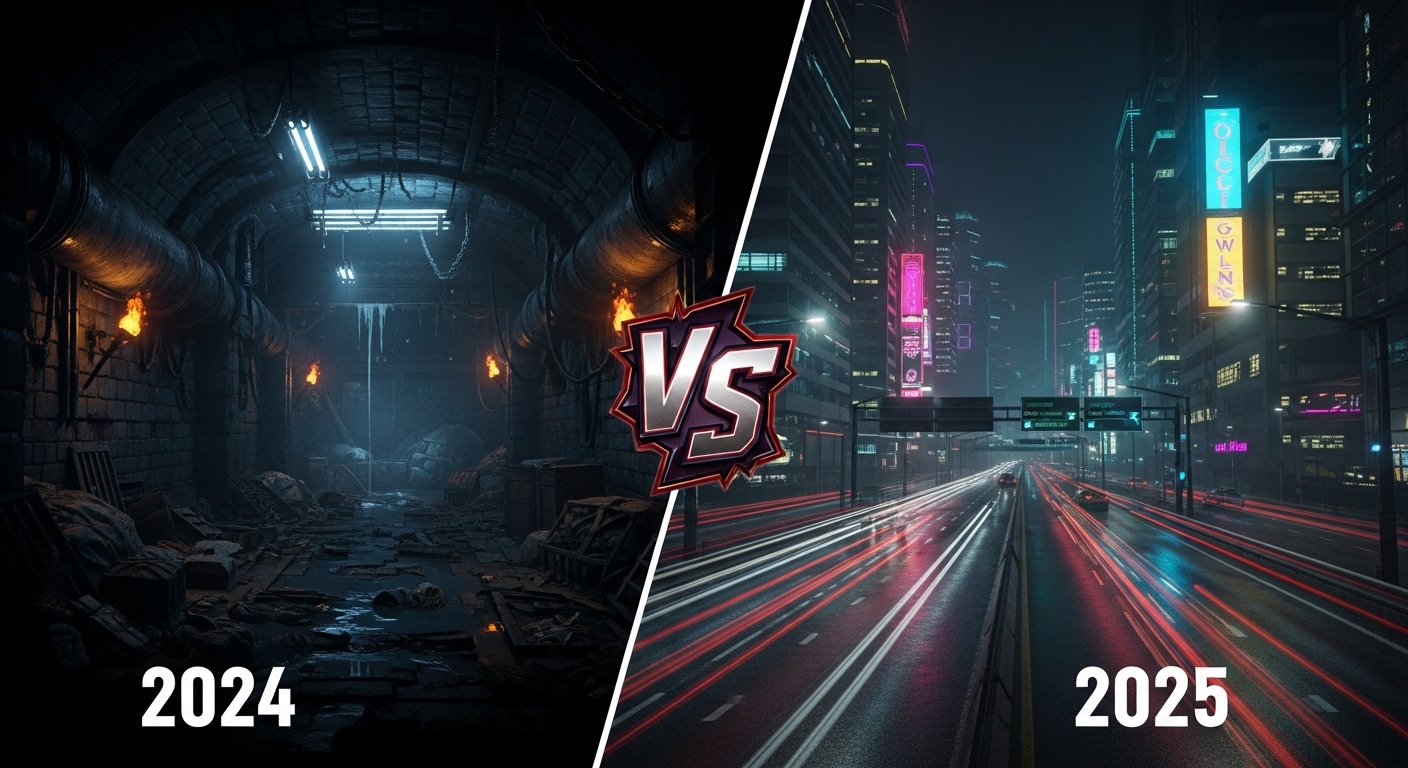
Visual & Theme Changes
When Chicken Road 1 launched in 2024, InOut Games went with a gritty, low-light aesthetic. The sewer and dungeon environment gave the game a dark, subterranean mood — dimly lit corridors, stone textures, and a slightly menacing atmosphere. The chicken protagonist navigated through shadowy underground passages, crossing obstacles that felt genuinely dangerous. This design worked well for players who appreciated the tension of the setting: every lane felt like it could be the last.
Chicken Road 2, released in 2025, made a bold tonal shift. The sequel moves the action above ground and out into open daylight on a busy highway. Vivid colors, speeding vehicles, road markings, and a bright sky create a completely different visual identity. The feel is more arcade, more energetic, and arguably more accessible. Where CR1 felt like a dark puzzle, CR2 feels like a fast-paced reflex challenge under the sun.
The target audience implications are clear. CR1's dungeon aesthetic appealed to players who enjoyed dark, atmospheric games — the kind of visual design common in horror-adjacent titles. CR2's highway theme is broadly accessible, familiar from classic arcade sensibility, and likely to attract a wider demographic including casual players who find the dungeon setting uninviting. Neither theme is objectively superior, but CR2 will resonate with more players simply due to its brightness and immediately understandable visual language.
Sound design also reflects this shift. CR1 used underground ambient sounds, dripping water effects, and lower-frequency impact sounds when losing. CR2 replaces these with engine roars, tire squeals, and brighter, more satisfying sound feedback on successful lane completions. The result is a more rewarding audio loop that reinforces continued play.
Difficulty System Changes
The most numerically significant changes in Chicken Road 2 involve the difficulty system. InOut Games expanded the number of lanes available at every tier, and these are not cosmetic additions — they have direct mathematical consequences for both risk and reward.
Easy Mode: 24 → 30 Lanes
This is the biggest absolute increase in the entire game. Going from 24 to 30 Easy lanes represents a 25% expansion in the number of multiplier steps available before the chicken reaches the end. For beginners, this means the multiplier curve is smoother. There are more intermediate cash-out points, which makes it easier to exit at a comfortable multiplier without feeling forced into a high-risk all-or-nothing scenario.
Mathematically, each lane in Easy mode represents a relatively low collision probability. With 30 lanes instead of 24, the maximum achievable Easy multiplier is proportionally higher, while the risk per individual lane remains constant. Players using a "stop at x10" strategy, for example, will reach that target at a lower proportional point in the overall run, giving them more room to continue pushing if they choose.
Medium Mode: 22 → 25 Lanes
Medium mode saw a modest but meaningful increase of 3 lanes. This is the difficulty tier most intermediate players gravitate toward — it offers genuine tension without the extreme variance of Hard or Hardcore. The additional lanes give medium-difficulty players more decisions per run, which increases engagement and extends average session time.
Hard Mode: 20 → 22 Lanes
The smallest proportional change. Hard mode gained 2 lanes, going from 20 to 22. At this difficulty, collision probability per lane is substantially higher than Easy or Medium. The addition of 2 extra lanes is meaningful for players who consistently reach the 18–20 lane range, as it unlocks higher maximum multipliers for those willing to push further.
Hardcore Mode: 15 → 18 Lanes
Hardcore mode gained 3 lanes — a 20% expansion from 15 to 18. This is the tier where maximum win calculations are generated. The increase from 15 to 18 Hardcore lanes is directly responsible for the higher theoretical maximum win in CR2 (x3,608,855 vs x3,203,384). Each additional lane at Hardcore level multiplies the potential payout exponentially, because the multiplier compounds across every successful crossing.
Key takeaway: CR2's expanded lane counts benefit beginners the most in Easy mode (+6 lanes) and max-win hunters the most in Hardcore mode (+3 lanes, enabling the higher max win). The middle difficulties saw incremental but meaningful improvements.
RTP Deep Dive: 98.1% vs 95.5%
RTP — Return to Player — is the single most important number for evaluating the long-term economics of any casino game. It represents the theoretical percentage of all wagered money that is returned to players over a statistically significant number of rounds. The remaining percentage goes to the house as its mathematical edge.
Chicken Road 1's RTP of 98.1% is exceptionally high by industry standards. For context, most slot games operate at 94–96% RTP. A 98.1% RTP means the house edge is only 1.9% — for every $100 wagered on average, the game returns $98.10 to players. This positions CR1 among the most player-friendly games in any online casino lobby.
Chicken Road 2 drops to 95.5% — still above average for the industry, but a meaningful reduction. The house edge increases from 1.9% to 4.5%. This 2.6 percentage point difference may sound small, but it compounds significantly with volume.
The difference is stark. A player wagering $1,000 in total stakes expects to lose $19 on CR1 but $45 on CR2 — more than twice as much. This is a theoretical long-run figure; any individual session can vary wildly above or below this average. However, for high-frequency players or those with large bankrolls, the RTP gap directly impacts the total amount they can expect to play through before depleting their funds.
Why did InOut Games reduce the RTP in the sequel? There are several likely reasons. First, the higher lane counts in CR2 increase the theoretical maximum win significantly. Offering a path to x3,608,855 requires that the mathematical model generate that funding somewhere, and reducing base RTP is the standard mechanism. Second, the expanded lane system naturally extends play sessions and increases total wagering volume, partially offsetting the lower per-unit return for players. Third, the higher max win creates more excitement around big wins, which generates marketing value even if most players never reach those amounts.
Does the higher max win compensate for the lower RTP? Only for a tiny fraction of players. The overwhelming majority will never come close to the theoretical maximum. For the average player, the lower RTP represents a real reduction in expected value that is not offset by the increased maximum win potential. Players who prioritize bankroll longevity should be aware of this trade-off before choosing CR2 over CR1.
Max Win Changes
The theoretical maximum win in Chicken Road 2 is x3,608,855, compared to x3,203,384 in Chicken Road 1. This represents an increase of approximately 12.7%. The numbers are astronomical in isolation — a $1 bet at maximum multiplier would theoretically return over $3.6 million — but understanding how these figures are generated is essential for rational expectations.
Both maximum wins are achieved exclusively through Hardcore mode. The chicken must successfully cross every single Hardcore lane without triggering a collision, and crucially, the player must resist the temptation to cash out at any point during the run. The multiplier compounds with each successful crossing, with each successive lane applying a progressively larger multiplier to the cumulative total.
CR2's increase in Hardcore lanes from 15 to 18 directly generates the higher maximum. Three additional lanes at the highest difficulty tier, where collision probability is greatest, each contribute multiplicatively to the final figure. This is also why the max win increase (about 12.7%) outpaces the lane increase (20%) — the relationship between additional lanes and final multiplier is not linear but exponential.
In practical terms, the maximum win is an extreme theoretical ceiling that almost never occurs. Its primary value is psychological: it defines the upper bound of excitement and represents the dream scenario. The higher max win in CR2 makes the game marginally more aspirational, but players should plan sessions around realistic multiplier targets, not maximum win scenarios.
Gameplay Feel
Beyond the statistics, CR2 delivers a noticeably different moment-to-moment gameplay experience. The pace in CR2 feels slightly faster than CR1. Lane transitions happen more quickly, and the visual feedback on each successful crossing is more immediate and satisfying. Where CR1's dungeon setting sometimes made it feel like the chicken was cautiously creeping through darkness, CR2's highway theme creates a sense of speed and momentum.
The additional lanes in CR2 also change the psychological rhythm of a run. In CR1's Easy mode, 24 lanes provide a certain density of decision points. CR2's 30 Easy lanes create a longer, more gradual build of tension. Players report that CR2 Easy feels more like a slow build toward a meaningful peak, while CR1 Easy reaches peak tension faster due to the shorter lane count.
Visual feedback improvements in CR2 are significant. The collision animation in CR2 is more dramatic, making losses feel more impactful but also more cinematic — less of a frustrating sudden stop and more of a satisfying "I pushed my luck" moment. The cash-out confirmation in CR2 is cleaner and faster, reducing the friction between decision and execution. For players using strategies that involve precise cash-out timing, this responsiveness matters.
Overall, CR2 plays smoother, looks more polished, and rewards longer sessions with a more gradual tension curve. These qualitative factors are hard to quantify but are consistently noted by players who have experienced both titles.
Who Should Play Which Game
Beginners: Play CR2 Easy Mode
New players benefit most from CR2's Easy mode. The 30-lane Easy difficulty offers the most forgiving multiplier curve in either game. With more cash-out points and a gentler risk gradient, beginners can learn the mechanics, understand how multipliers compound, and practice discipline (knowing when to cash out) without burning through their bankroll rapidly. The modern visual design of CR2 also provides a more intuitive first impression.
High-Volume Grinders: Play CR1
If you plan to wager large volumes over extended sessions, CR1's 98.1% RTP is a significant financial advantage. Over thousands of rounds, the 2.6% RTP difference between CR1 and CR2 translates to a real reduction in expected losses. Professional or semi-professional players who treat RTP as the primary optimization variable should default to CR1.
Maximum Win Hunters: Play CR2 Hardcore
Players whose primary goal is to target the highest possible multiplier should play CR2. The 18 Hardcore lanes and x3,608,855 theoretical maximum make it the superior choice for high-risk, high-reward strategies. The additional Hardcore lanes also provide more opportunity to find a stopping point at very high multipliers that still fall short of the absolute maximum.
Casual Players: Play CR2
For players who just want an enjoyable, visually appealing session without strategic optimization, CR2 is the clear choice. It looks better, sounds better, plays more smoothly, and the highway theme is broadly appealing. The lower RTP is unlikely to be a conscious concern for casual players who treat losses as an entertainment cost rather than a financial optimization problem.
Verdict
Chicken Road 2 is the better choice for the majority of players, despite its lower RTP. The expanded lane counts — particularly the 25% increase in Easy mode and the 20% increase in Hardcore mode — provide a meaningfully better gameplay structure. More lanes mean more decision points, smoother multiplier curves, and a higher theoretical ceiling for maximum wins.
CR2's modern highway theme and improved visual and audio design make it more enjoyable on a session-by-session basis. For casual players, newcomers, and max-win hunters, CR2 is the correct choice.
The exception is high-volume players who are acutely aware of RTP and manage their bankroll mathematically. For this specific group, CR1's 98.1% RTP provides a 2.6% reduction in expected losses that compounds significantly with volume. These players should stick with CR1.
Our overall recommendation: start with CR2. Once you understand the game deeply and begin playing with larger stakes over longer sessions, revisit CR1 for its superior RTP. Having both options available at your casino of choice is the optimal setup.
Frequently Asked Questions
Ready to Play Chicken Road 2?
Experience all 30 Easy lanes, the Highway theme, and a theoretical max win of x3,608,855 at a licensed casino.
🎮 PLAY CHICKEN ROAD 2 NOW18+ only. Gambling involves risk. Play responsibly. Responsible Gaming