HOW TO PLAY CHICKEN ROAD 2: COMPLETE GUIDE
Master every mechanic, difficulty level, and control in Chicken Road 2 by InOut Games. Whether you're brand new or coming from Crash games, this guide walks you through every step of the gameplay loop.
📋 Table of Contents
01 Introduction to Chicken Road 2
Chicken Road 2 is an arcade crash game developed by InOut Games, released on April 15, 2025. It builds on the original Chicken Road concept and elevates it with a dramatic highway setting, four selectable difficulty modes, and a provably fair system that gives players genuine transparency into every outcome.
The premise is deceptively simple: your chicken character must cross a multi-lane highway one lane at a time. Every time you press GO and survive, a multiplier compounds on your bet. Press GO at lane 1 and walk away — small reward. Push through all 30 lanes on Easy, or all 18 on Hardcore — the theoretical maximum multiplier is a jaw-dropping x3,608,855.
What separates Chicken Road 2 from pure luck-based slots is the decision element. You choose when to stop. Unlike slots or roulette where outcomes happen to you, here you have an active role in every round. This creates a compelling skill-meets-chance dynamic that has made it one of the fastest-growing crash games in the InOut Games catalog.
This guide covers everything from your first session to advanced mechanics. If you want to jump straight in, you can play the free demo before reading any further — sometimes the best way to learn is to play.
02 What Makes Chicken Road 2 Different
The original Chicken Road placed its brave bird in a sewer environment with a single difficulty setting. Chicken Road 2 overhauls this formula entirely, replacing the sewer with a fast-moving multi-lane highway — a setting that's both more visually dynamic and mechanically deeper.
Key Upgrades Over Chicken Road 1
- Highway theme: Moving cars, dynamic traffic patterns, and lane-specific risk create a more immersive visual experience compared to the original sewer setting.
- SHA-256 Provably Fair: Every round is cryptographically verifiable. Before each round begins, a hash is displayed. After the round, the seed is revealed. Anyone can verify the result using a standard SHA-256 calculator.
- Four difficulty modes: Easy (30 lanes), Medium (25 lanes), Hard (22 lanes), and Hardcore (18 lanes). Each changes the frequency and timing of vehicles, directly affecting your bust probability per lane.
- Multipliers up to x3,608,855: While the maximum is theoretical, the compounding multiplier system means that even early cash-outs on Hard or Hardcore modes produce substantial multipliers compared to Easy mode.
- No RNG black box: Unlike slot machines where the RNG is invisible, Chicken Road 2's provably fair architecture means you can independently confirm the fairness of each round after it concludes.
- Mobile-first design: The tap-to-advance mechanic was built for touchscreen play from the ground up, making mobile sessions feel natural rather than adapted from desktop.
These improvements collectively make Chicken Road 2 one of the more transparent and player-friendly crash games available in 2026. The combination of player agency, verifiable fairness, and variable difficulty is rare in this category.
03 Step-by-Step Gameplay
Here is the complete gameplay loop broken down into five actionable steps. Follow these in order for your first session.
Chicken Road 2 is available at online casinos that carry the InOut Games game library. Not every casino offers InOut Games, so you'll need to register at a platform that does. Our recommended starting point is via this link, which takes you to a casino with Chicken Road 2 available and a welcome bonus for new players.
Once registered and logged in, navigate to the Crash Games or Instant Win section of the casino's game lobby. Search for "Chicken Road 2" or look under the InOut Games provider filter. The game loads directly in your browser — no download, no app installation required on either desktop or mobile.
If you prefer to test before committing real money, many casinos allow demo play without registration. Simply click "Play for Free" or "Demo" on the game tile. You'll get virtual chips to practice with. We strongly recommend at least 20–30 demo rounds before your first real money session.
The game interface will load with a highway scene, your chicken positioned at the start, and controls at the bottom of the screen. Before pressing anything, take a moment to review the difficulty selector and bet field — you'll set these before each round begins.
Before each round, select your difficulty level from the mode selector. There are four options: Easy (30 lanes), Medium (25 lanes), Hard (22 lanes), and Hardcore (18 lanes). The number of lanes refers to the total number of traffic lanes your chicken must cross to complete the entire highway.
If you're a beginner, start with Easy. The vehicle frequency is lowest on Easy, giving you more time to react and making each lane crossing safer. The trade-off is that Easy mode multipliers grow more slowly — a full 30-lane run on Easy produces a fraction of what a full 18-lane Hardcore run would yield.
Intermediate players typically gravitate toward Medium or Hard once they've internalized the timing mechanics. Hardcore is recommended only for players who are comfortable with high variance and have a defined bankroll strategy, as bust rates are significantly elevated at this level.
The difficulty setting can be changed between rounds. Many players try different levels during a session to find their comfort zone. Note that your difficulty choice affects both the risk per lane and the multiplier increment per successful crossing — Hardcore mode has a steeper multiplier curve to compensate for its higher risk.
After selecting difficulty, set your bet for the round in the bet input field. The minimum bet is $0.01 and the maximum is $200. You can type a value directly or use the quick-increment buttons if your casino provides them (common options: +$1, +$5, +$10, ×2).
A foundational bankroll principle: never wager more than 1–2% of your total session budget on a single round. If you have $100 allocated for a session, keep each bet between $1 and $2. This ensures you can sustain a long session even through a losing streak, and allows the law of large numbers to work in your favor.
Avoid the common trap of increasing your bet after losses to "recover" — this is the martingale fallacy and leads to rapid bankroll depletion in high-variance crash games. Chicken Road 2 can produce several consecutive busts on Hard or Hardcore, and a doubling strategy during a bad streak will exhaust a bankroll faster than any other factor.
Your bet amount is fixed for the entire round once you press GO for the first lane. You cannot change it mid-round. The potential payout at any moment is displayed as Bet × Current Multiplier.
With your bet set and difficulty selected, you're ready to begin. The chicken stands at the roadside, waiting for your command. To advance one lane, press the Spacebar on desktop or tap the GO button on mobile. The chicken will dash across that lane, and if no vehicle hits it, it successfully lands on the other side.
Each successful crossing increments the multiplier. The increment varies by difficulty level — on Hardcore, each lane adds a larger multiplier jump than on Easy. The current multiplier is displayed prominently in the center of the screen, updating in real-time with each crossing.
The timing window for each lane is not infinite. A vehicle will eventually cross at your chicken's position. The key is reading the traffic pattern and pressing GO when a gap is available. On Easy mode, gaps are wider and more forgiving. On Hardcore, gaps are narrow and the penalty for poor timing is swift. With practice, the rhythm of reading traffic becomes second nature.
You can pause between lane crossings as long as needed — there is no round timer forcing you to advance. Use this time to assess your current multiplier, compare it to your pre-set target, and decide whether the risk of the next lane is worth the marginal gain. This deliberative element is what distinguishes skilled players from impulsive ones.
At any point after successfully crossing at least one lane, you can cash out and lock in your current multiplier as your winnings. This is the most critical decision in every round. The cash-out button is always visible and accessible — don't hesitate to press it when you reach your target.
The art of Chicken Road 2 is reading risk correctly. A player who consistently cashes out at lane 6 on Medium mode with a modest multiplier will, over hundreds of rounds, perform better than a player who always tries to reach lane 20 and frequently busts. Expected value favors disciplined, pre-planned exits over reactive ones.
If a car hits your chicken before you cash out, the round ends immediately. You lose your entire bet for that round. There is no partial recovery — it's all or nothing once the bust occurs. This binary outcome is the core tension of all crash-style games and is what makes early cash-outs a legitimately valid strategy rather than timid play.
After a bust or a successful cash-out, the round resets. Your chicken returns to the start of the highway, and you set your next bet. The round history strip at the bottom of the screen shows recent outcomes, which can help you track your session performance.
04 Difficulty Levels Explained
| Level | Lanes | Risk | Multiplier Range | Best For |
|---|---|---|---|---|
| Easy | 30 | Low | x1.01 — ~x1.8 | Beginners, low variance |
| Medium | 25 | Medium | x1.02 — ~x5 | Balanced play, learning |
| Hard | 22 | High | x1.03 — ~x50 | Experienced players |
| Hardcore | 18 | Extreme | x1.05 — x3,608,855 | High rollers, thrill seekers |
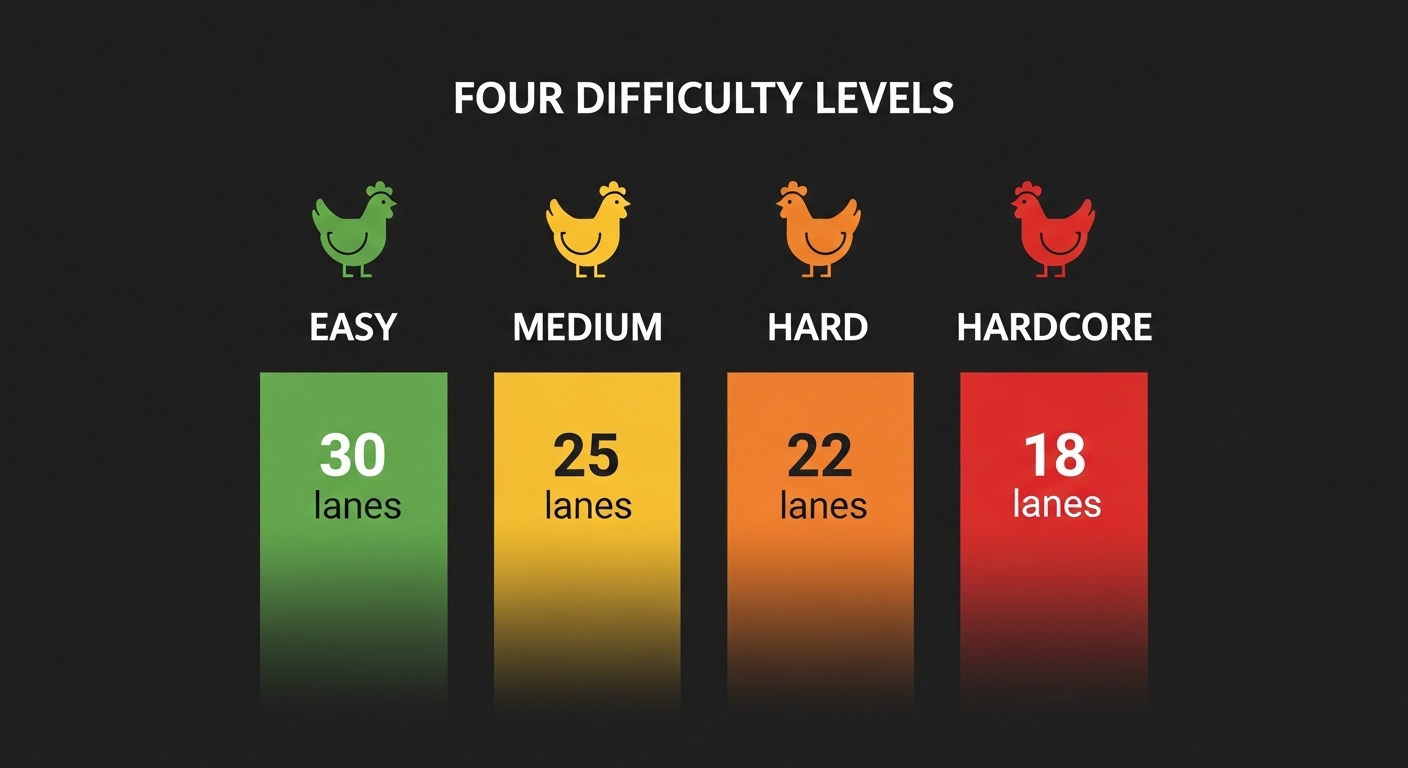
Easy mode is the ideal entry point. Vehicles are infrequent, gaps are wide, and the full 30-lane crossing is achievable for most players once they learn the timing. The downside is the modest multiplier ceiling — completing all 30 lanes yields approximately x1.8, which is decent but not exciting. Easy is best for building confidence, understanding the mechanic, and practicing consistent cash-out discipline at pre-set lanes (e.g., always cashing at lane 10 for a small but reliable gain).
Medium is the most popular mode among regular players. The 25-lane structure offers enough multiplier growth to produce meaningful returns on modest bets, while keeping bust frequency at a level that doesn't dominate sessions. A strategy of cashing out at lanes 8–12 on Medium hits the sweet spot between risk and reward for most bankroll sizes. The x5 theoretical ceiling at full crossing makes bigger payouts possible without the extreme variance of Hard or Hardcore.
Hard mode is for players who have mastered the timing on Medium and want to push multipliers further. The 22 lanes and elevated vehicle frequency mean busts are common, especially in the mid-to-late lanes. Early exits (lanes 4–7) are a popular strategy here — absorbing the higher per-round bust risk in exchange for the steeper multiplier curve. A successful full run on Hard can yield approximately x50, making it an attractive mode for session-peak hunting.
Hardcore is where Chicken Road 2's legendary maximum multiplier of x3,608,855 lives. With only 18 lanes and extreme vehicle frequency, bust rates are high per lane. Most Hardcore rounds end in the first few lanes. However, the compounding multiplier per lane is dramatically steeper than any other mode — surviving just 10–12 lanes on Hardcore can produce a multiplier that would require a full completion on Easy to approach. This mode is for experienced players with defined high-risk strategies and the bankroll to sustain it.
The relationship between difficulty and multiplier growth is compounding: each lane multiplies the previous result by a mode-specific factor. This is why Hardcore's theoretical maximum is so extreme despite having fewer lanes — the per-lane multiplier factor is exponentially larger.
05 Interface Breakdown
Understanding every element of the Chicken Road 2 game screen will help you make faster decisions and avoid confusion during real-money play. Here's a complete breakdown of the game's UI components.
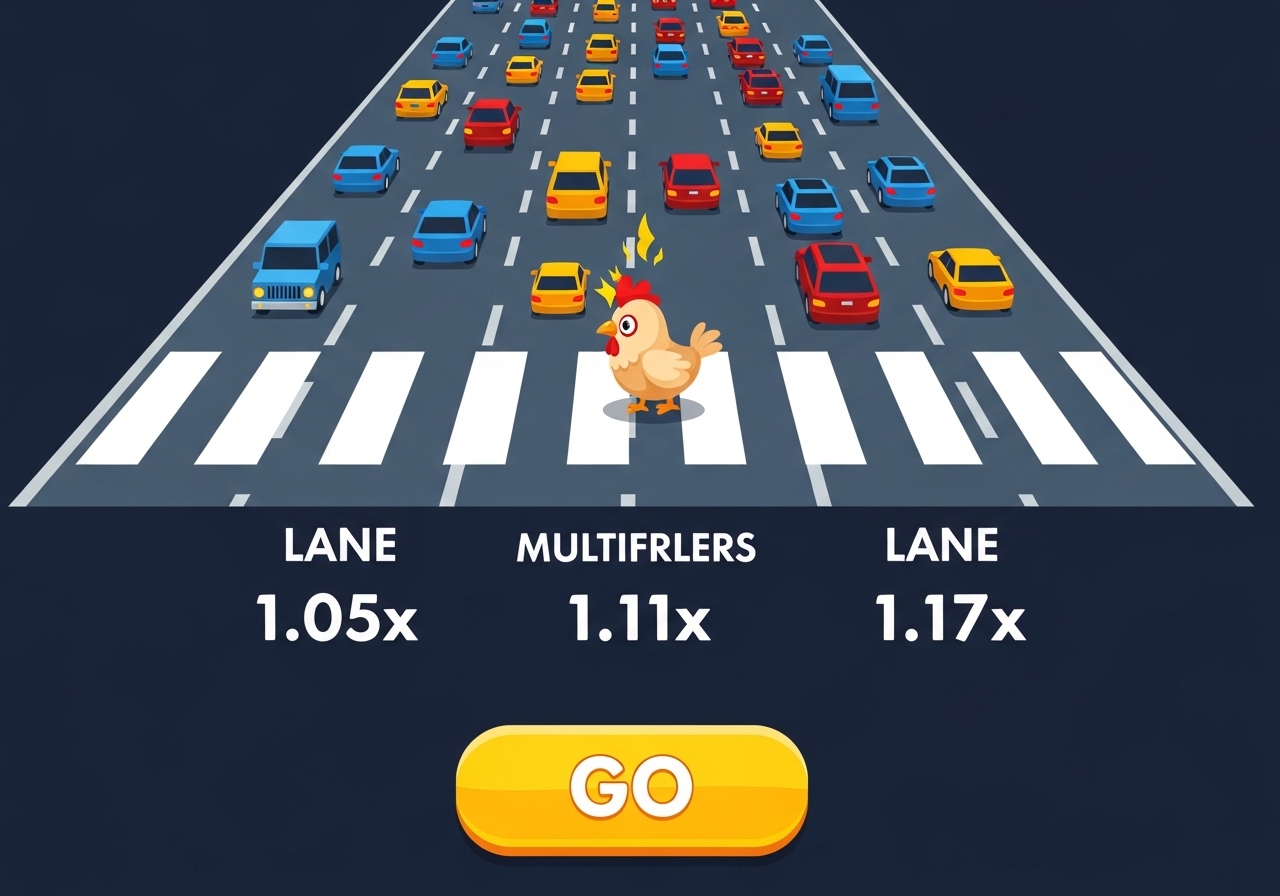
The main playing field. Lanes run horizontally. Vehicles cross from right to left (or vice versa). The number of lanes shown equals your selected difficulty total.
Your character. Positioned at the left edge before the round starts. Moves right with each successful lane crossing. The animation shows the chicken running and reacting to near misses.
Displayed prominently at the top center of the screen. Updates after each successful crossing. Shows your current potential payout as Bet × Multiplier in some casino implementations.
Input field at the bottom of the interface. Set before each round. Cannot be changed mid-round. Displays the total amount at risk for the current round.
The central action button. Before crossing a lane it shows GO. After crossing at least one lane, it can be used to cash out. On desktop, Spacebar activates this.
A horizontal scrolling bar at the bottom showing recent round outcomes — multipliers achieved or bust indicators. Useful for tracking session variance at a glance.
The SHA-256 hash displayed before each round begins. Record this to verify the round's outcome after it concludes. Located in a collapsible section near the betting controls.
Four-option selector (Easy / Medium / Hard / Hardcore) visible between rounds. Some casinos display this as tabs; others as a dropdown. Changes take effect at the start of the next round.
Optional field in some casino implementations allowing you to set a target multiplier at which the game automatically cashes out. Useful for executing a consistent exit strategy.
The interface is intentionally minimal — InOut Games designed Chicken Road 2 to keep player focus on the highway action and the cash-out decision, rather than cluttered UI elements. Mastering the layout takes only a few rounds, after which the controls become instinctive.
Note that the exact visual layout can vary slightly between casinos, as different platforms may skin the InOut Games engine with their own theme. However, all functional elements (multiplier display, bet field, GO button, round history, hash) are present on every compliant implementation.
06 Controls & Hotkeys
Chicken Road 2 is designed for single-button or single-tap gameplay, but there are several controls worth knowing to optimize your session speed and accuracy.
Auto-Advance for Demo Testing
Some casino implementations of Chicken Road 2 include an auto-advance toggle that automatically attempts each lane crossing at a predetermined timing. To enable this in demo mode, look for a toggle labeled "Auto" or "Auto-Play" in the game's settings panel (usually accessible via a gear icon). This mode is useful for observing outcome distributions over many rounds without manual input, but is not recommended for real money play as it removes the human judgment element.
When auto-advance is enabled, the game will press GO automatically until either a bust occurs or your pre-set exit lane is reached (if you've configured an auto-stop target). This is primarily useful for strategy testing in demo mode, where you want to see how a fixed-exit strategy performs over 50–100 rounds without pressing Spacebar for each one.
Pro tip on timing: On Hard and Hardcore modes, the timing window per lane is narrower. Players who rush through lanes without reading traffic patterns bust more frequently than those who wait for optimal gaps. There is no penalty for hesitation — take your time, especially in the higher-risk lanes 10–15 where multipliers are growing rapidly.
07 Auto Game Mode
Some casinos that carry Chicken Road 2 offer an auto-bet feature that runs multiple rounds automatically without manual intervention for each round. This is distinct from the single-round auto-advance discussed in the controls section — auto-bet repeats full rounds sequentially.
How Auto-Bet Works
In auto-bet mode, you configure: (1) the number of rounds to run, (2) the bet amount per round, (3) the exit lane or target multiplier, and (4) stop conditions such as a profit target or a maximum loss limit. Once started, the system executes each round automatically, cashing out at your pre-set exit point if reached, or registering a bust if it occurs before that point.
Advantages of Auto Mode: Consistent execution of your strategy without emotional interference. Human players often change their mind mid-session — extending a round because "it feels like a good run" or chickening out earlier than planned after a few busts. Auto-bet enforces the mechanical discipline of your strategy exactly.
Disadvantages of Auto Mode: It eliminates the in-round judgment that separates experienced players from mechanical ones. Reading live traffic patterns and adapting your exit based on how the current round is developing is a real skill that auto-mode bypasses. For players still learning the game, auto-mode can also deplete a bankroll very quickly if stop conditions aren't set correctly, since rounds execute faster than manual play.
Recommendation
Use auto-mode sparingly and only in demo mode until you fully understand its behavior. For real money play, manual mode is strongly recommended for all but the most disciplined strategy executors. The game's pace is slow enough that manual decisions are feasible, and the flexibility to adapt in real-time is a genuine edge that auto-mode surrenders.
08 Provably Fair Verification
✓ SHA-256 Provably Fair System
Chicken Road 2 uses a SHA-256 cryptographic hash function to make every round independently verifiable. This is one of the most important features of the game — it means you never have to take InOut Games' word that outcomes are fair.
Before every round begins, the game displays a SHA-256 hash of the round's seed. After the round completes, the actual seed is revealed. By feeding the seed through any SHA-256 calculator (freely available online), you can confirm that the displayed hash matches — proving the seed wasn't changed after the round started.
Step-by-Step Verification
- Before the round: Note the hash displayed in the game's provably fair section (e.g., a string like "3d7f2a9c1b...").
- Play the round normally — the hash is your commitment from the game provider.
- After the round: The game reveals the seed (e.g., "8f4a2b1c9d7e3f...").
- Open any SHA-256 tool (browser-based, no installation needed) and hash the revealed seed.
- Compare the result to the pre-round hash. If they match, the round was not manipulated.
Why this matters: In traditional online casino games, the RNG is a black box — you have no way to verify that the provider didn't manipulate the outcome. Provably fair systems eliminate this trust requirement. InOut Games cannot change the outcome after displaying the pre-round hash without producing a different hash, which would be immediately detectable.
This doesn't mean you'll win more often — the outcomes are still random. But it does mean you can verify, with mathematical certainty, that you're playing a fair game. Most reputable online casinos that carry Chicken Road 2 display the hash prominently and make verification instructions available in the game's help section.
09 Betting Limits & Potential Payouts
| Parameter | Value | Notes |
|---|---|---|
| Minimum Bet | $0.01 | Available on all difficulty modes |
| Maximum Bet | $200.00 | Per round limit across all modes |
| Maximum Win | $20,000 | Casino payout cap (platform-dependent) |
| Theoretical Max Multiplier | x3,608,855 | Hardcore full completion (18/18 lanes) |
| Theoretical Max Payout | $200 × x3.6M | Capped by casino max win rules |
| Theoretical RTP | 95.5% | Across all difficulty modes |
The relationship between the theoretical maximum multiplier and real-world payouts requires understanding casino win caps. Most casinos set a maximum single-round payout — commonly $20,000 for Chicken Road 2. This means that while the x3,608,855 multiplier is theoretically achievable on Hardcore, a $0.01 bet fully completed would yield $36,088.55 — exceeding the typical $20,000 cap.
For practical purposes, the effective maximum payout at a $0.01 minimum bet is $20,000 (the casino cap). At the maximum bet of $200, a x100 multiplier — achievable on Medium or Hard mode with moderate lane penetration — already produces a $20,000 payout. This means high-bet players hit the win cap at much lower multipliers than low-bet players.
Practical planning: If your goal is to hit the casino win cap, calculate the minimum multiplier needed for your bet size. At $50/round, you need x400 to hit $20,000. At $1/round, you need x20,000. This informs which difficulty level makes sense for your bet size — Hardcore is more relevant for small bets hunting extreme multipliers, while Medium or Hard make more sense for larger bets targeting $20,000 via lower multipliers.
10 Common Beginner Mistakes
Easy mode has low vehicle frequency, but a full 30-lane run is never guaranteed. Busts can and do happen on Easy, especially in the later lanes. Many beginners assume Easy is risk-free and push for a full completion every round, then are surprised when they bust at lane 27. No lane on any difficulty is "safe" — Easy simply has a lower bust probability per lane, not zero. Set a target (e.g., cash out at lane 10 or 15) and stick to it, even on Easy.
After a bust, the impulse to bet double to "recover" is one of the most dangerous patterns in any crash game. Chicken Road 2 busts are independent events — the game has no memory. A bust on round 5 doesn't reduce the probability of a bust on round 6. Doubling bets after losses (Martingale strategy) can create the illusion of recovery in short sessions, but in any extended session it leads to catastrophic bankroll drawdowns when a bust streak of 4–6 rounds occurs, which is statistically inevitable at Hard and Hardcore.
Chicken Road 2's demo mode is available for free with no registration required on most platforms. Skipping it and jumping straight into real-money play means learning the timing mechanics with your bankroll at risk. The first 20–50 rounds are predominantly a learning curve — understanding vehicle timing, multiplier progression, and cash-out discipline. Running these learning rounds in demo mode costs nothing and builds genuine mechanical competence before your money is involved.
The SHA-256 hash displayed before each round is the game's guarantee of fairness. Most beginners ignore it entirely. While not verifying every round is understandable, neglecting to understand the system means you're missing a key consumer protection feature. At minimum, run a few manual verifications using the post-round seed and a SHA-256 tool. This builds confidence in the game's legitimacy and helps you understand what "provably fair" actually means in practice.
The x3,608,855 theoretical maximum is seductive for new players who immediately jump to Hardcore hoping to hit the extreme end. In practice, Hardcore's bust rate is extreme — many rounds end in the first 2–3 lanes. Without the timing experience built from Easy and Medium play, beginners on Hardcore will burn through a bankroll at a rate that prevents meaningful learning. Build your foundation on Easy, graduate to Medium, then Hard, and only move to Hardcore when you have genuine timing competence and a defined high-variance strategy.
Frequently Asked Questions
Ready to Play Chicken Road 2?
Try the free demo first to build your skills — no registration, no risk. Or jump straight to real money play with a welcome bonus.